The Automation Hour - 03
Presenters
Section titled “Presenters”- DVJD
Introduction and Agenda
Section titled “Introduction and Agenda”(0:07) Simon Amby introduced the automation hour session and mentioned that David would present on a new topic related to deployment. Simon also encouraged participants to suggest topics for future sessions.
Deployment Challenges
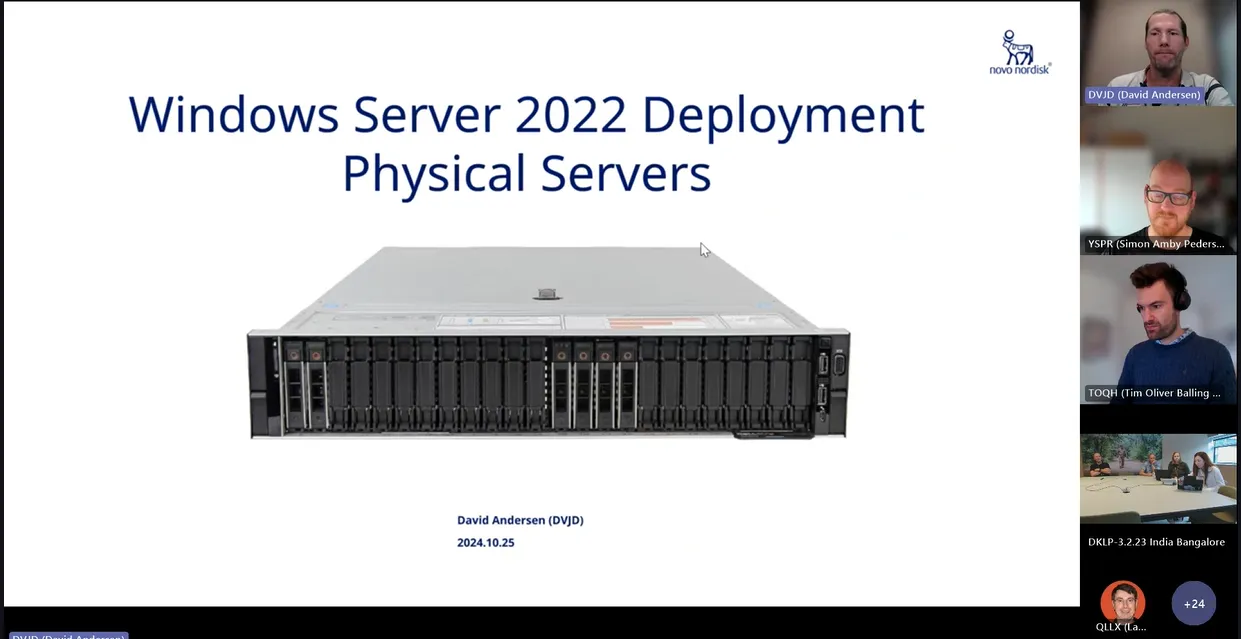
Section titled “Deployment Challenges”(1:40) David discussed the challenges faced by the Hyper V team in deploying physical servers without a deployment network. He explained the manual Windows installation process and the need for a smarter solution.
Answer File Solution
Section titled “Answer File Solution”(2:33) David introduced the concept of using an answer file to automate the Windows installation process. He explained how the answer file contains all the necessary answers for the installation, making the process more efficient.
Two-Part Installation Process
Section titled “Two-Part Installation Process”(3:32) David described the two-part installation process, where the first part involves using the answer file to install the basic Windows operating system, and the second part involves running a PowerShell script to install drivers, firmware, and patches.
Configuration File and Serial Numbers
Section titled “Configuration File and Serial Numbers”(5:05) David explained how the configuration file uses the server’s serial number to determine the specific configuration for each server. This allows for a more automated and accurate deployment process.
Video Demonstration
Section titled “Video Demonstration”(7:04) David showed a video demonstrating the entire deployment process, including preparing the server, creating a RAID, installing Windows, and running the PowerShell script to complete the installation.
Answer File Details
Section titled “Answer File Details”(14:33) In response to Rahul’s question, David provided more details about the answer file, explaining how it is created using Microsoft’s tools and how it interacts with the Windows installation process.
Scope of Deployment
Section titled “Scope of Deployment”(17:09) Simon asked about the scope of the deployment process, and David explained that it is currently used by the Hyper V team but can be adapted for other teams and hardware types.
Future Improvements
Section titled “Future Improvements”(19:18) Simon inquired about potential future improvements, and David mentioned that having a deployment network would allow for more advanced and automated solutions. However, the current process is designed for offline installations.
Comparison with WDS
Section titled “Comparison with WDS”(23:21) Chandra Prakash asked about the difference between this process and traditional WDS installations. David explained that WDS requires a deployment network, while this process is designed for offline installations.
Integration with SCCM
Section titled “Integration with SCCM”(26:35) Dan Gudmund suggested integrating the deployment process with SCCM for better management and automation. David agreed that this would be a logical next step for more comprehensive server management.