The Automation Hour - 08
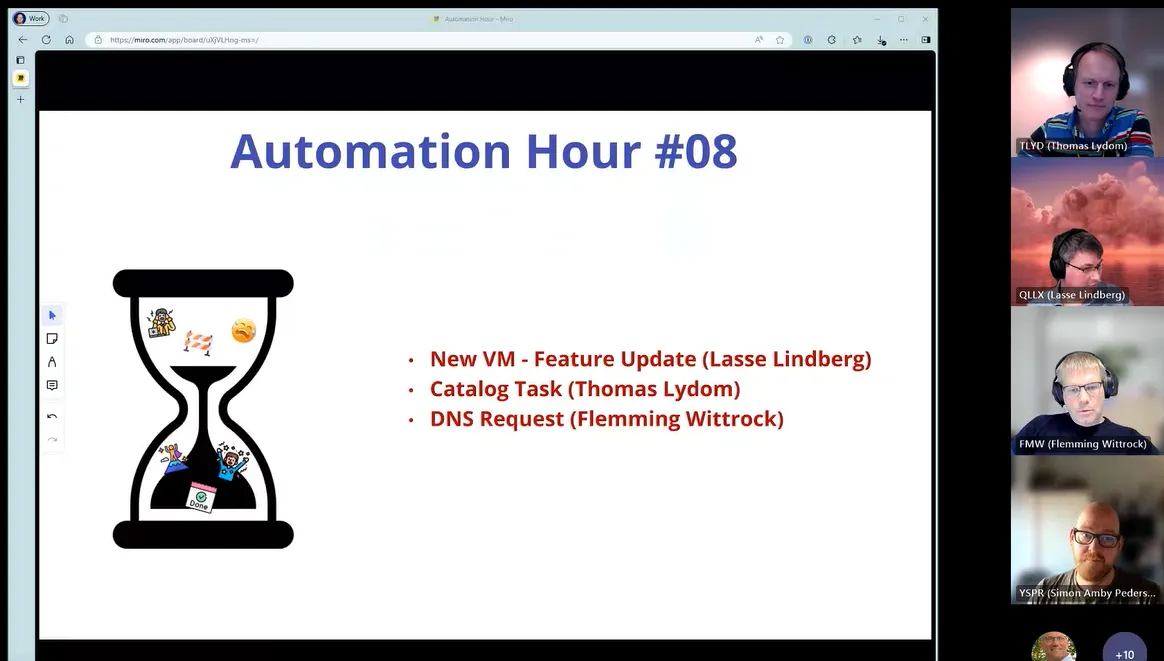
Presenters
Section titled “Presenters”- QLLX
- FMW
- TLYD
Automation of Meeting Recording and Transcribing
Section titled “Automation of Meeting Recording and Transcribing”(1:18) Simon Amby mentioned that the recording and transcribing of meetings now automatically starts when the meeting is opened, which is a new automated feature. Flemming confirmed that this is part of the feature pack installed.
Updates to VMware VM Creation Interface
Section titled “Updates to VMware VM Creation Interface”(2:39) Lasse presented updates to the VMware VM creation interface, highlighting the streamlined user interface and the inclusion of various features requested by colleagues. The process includes selecting a change number, deploying the server, configuring network adapters, and defining primary network adapters.
Server Deployment Tool Access
Section titled “Server Deployment Tool Access”(8:40) Casper inquired about the access to the server deployment tool and the associated costs. Flemming explained that people in key 2π can request access to the tool, and the deployment is documented in ServiceNow as part of the process.
Resource Availability Check
Section titled “Resource Availability Check”(10:30) Jens Nohr asked if there is a check for the availability of requested resources. Flemming responded that they are working on providing visibility on resource utilization, including CPU and memory, to help users make informed decisions before deploying servers.
SQL Server Installation Integration
Section titled “SQL Server Installation Integration”(14:53) Chethan C suggested integrating the SQL Server installation into the VM creation module. Flemming and Lasse agreed to discuss the possibility of making it a Configuration Manager (CM) package for easier integration.
Orchestration of Workflows
Section titled “Orchestration of Workflows”(20:50) Thomas discussed the importance of orchestrating workflows to ensure tasks are executed in the correct order and at the appropriate time. This helps in providing timely support, improving quality, and reducing lead time.
Shift Left and Self-Service
Section titled “Shift Left and Self-Service”(22:32) Thomas explained the concept of “shift left,” which aims to increase self-service and empower users by providing timely support and improving quality. This approach reduces lead time and frees up valuable time for both users and support teams.
Request Items and Catalogue Tasks
Section titled “Request Items and Catalogue Tasks”(24:08) Thomas described the difference between request items and catalogue tasks, emphasizing that request items help users order services easily, while catalogue tasks ensure the necessary steps are executed to fulfill the request.
DNS Record Request Template
Section titled “DNS Record Request Template”(30:06) Flemming demonstrated a DNS record request template created for the IIM team. The template allows users to request the creation or removal of DNS records, with the option to upload an Excel file for bulk requests. The process includes initial checks to ensure the safety of creating or removing records.
Manual Task and Approval Flow
Section titled “Manual Task and Approval Flow”(39:03) Christian Mark suggested using an approval flow instead of a manual task for DNS record removal. Flemming acknowledged the suggestion but noted the challenge of identifying the appropriate approver due to the current quality of ownership data in ServiceNow.